Welcome to the Gallery
-
![]()
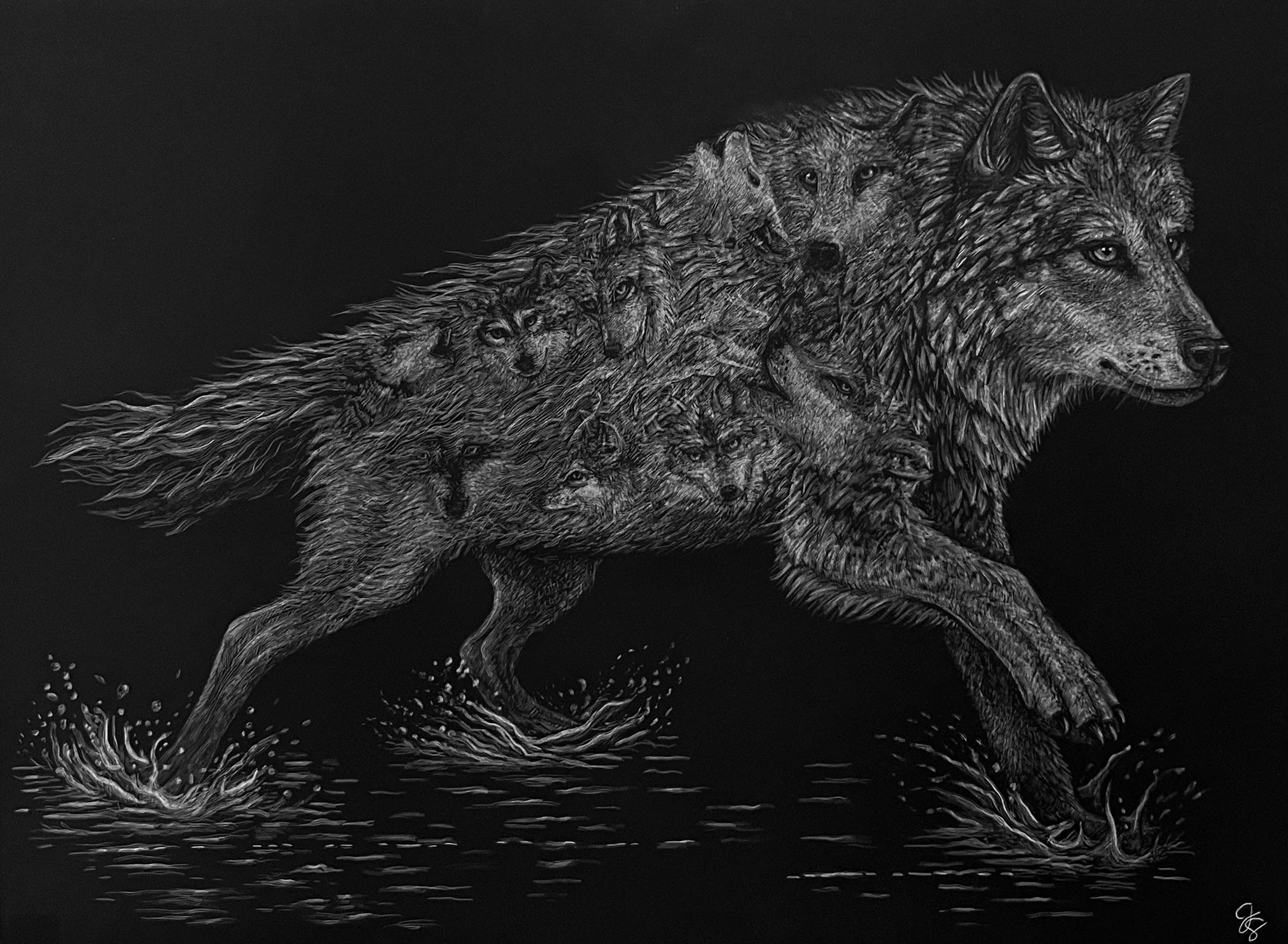
STANDING WITH WOLVES
16 x 12 inches
*Created for the International Wolf Center; will be featured at the International Wolf Symposium 2026
-
“As my Anishinaabe friend John Potter says, ‘Learn from wolves, not just about them.’” - Rick McIntyre, Thinking Like a Wolf
This piece was inspired by that simple yet profound idea.
The North American gray wolf moves forward with quiet confidence, each step embodying resilience, perseverance, and purpose. Its posture reflects a species that has endured generations of persecution and continual environmental change, surviving not through dominance alone, but through adaptability, intelligence, and an unwavering commitment to its pack.
Within the wolf's form are the faces of four regional populations of the North American gray wolf - the Arctic, Mexican, Great Plains, and Northwestern (Rocky Mountain) wolves. Each represents a distinct landscape and history, yet together they form a single wolf, symbolizing a species whose strength lies in both diversity and unity. As in every pack, the resilience of one depends upon the resilience of many.
The flowing water surrounding the wolf echoes these same qualities. Essential to all life, water is constantly adapting, nurturing, and reshaping the world around it while possessing immense strength. Hidden within the water are two words in Morse code that speak to the heart of the species and the message of this work, Resilient and Free.
Standing With Wolves is an invitation to look beyond long-held myths and reflect on what wolves can teach us about resilience, cooperation, and coexistence.
Perhaps, in learning from wolves rather than merely about them, we may better understand our own place in the natural world.
-
![]()
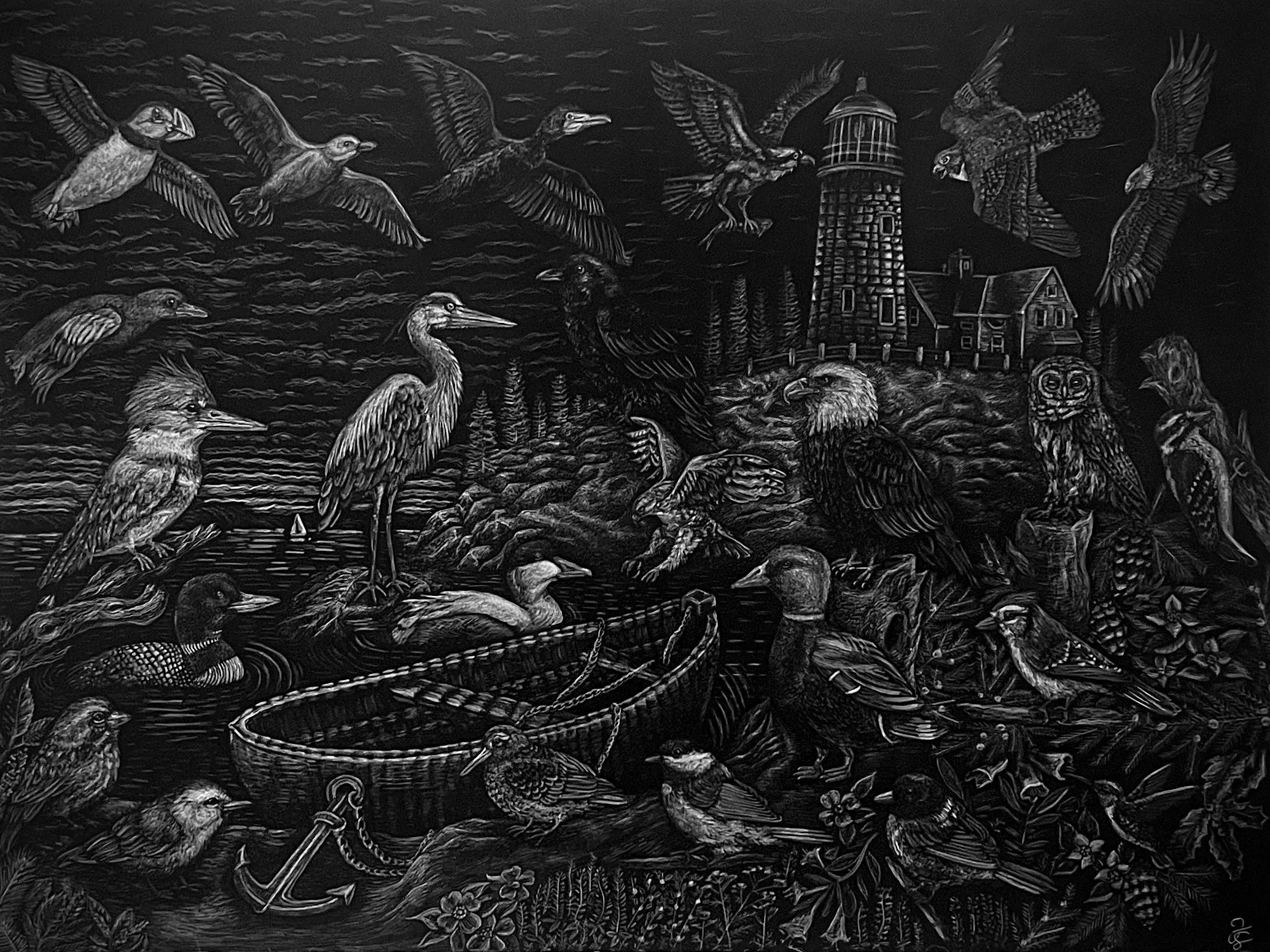
THOSE WHO LIGHT THE WAY
24 × 18 inches
Those Who Light the Way celebrates Maine’s vibrant birdlife and the landscapes that sustain it, while honouring a mentor whose wisdom and encouragement have helped others chart their own course.
Maine is a place where land and sea exist in remarkable harmony. It is a landscape defined not only by its beauty, but by its extraordinary avian diversity - from seabirds carried by the Atlantic winds to songbirds hidden among the forest canopy.
At its heart, this piece is about guidance.
The small boat represents a journey - one of curiosity, exploration and the courage to venture beyond familiar shores. Growth rarely comes from certainty; it comes from embracing the unknown, trusting the course ahead even when the destination lies beyond the horizon.
Standing watch over that journey is a lighthouse inspired by Monhegan Island. For generations, lighthouses have been symbols of steadfastness, offering direction through darkness and reassurance during uncertainty. Here, it represents a mentor who has offered wisdom without expectation, encouragement without condition, and guidance that has helped navigate many of life’s defining moments.
Like a lighthouse, teachers and guides do not steer the boat. Instead, they provide the light that allows us to find our own way.
This piece aims to serve as a lasting reminder of the profound impact one life can have on another - to illuminate a path and inspire confidence.
-
![]()
A CHAMBERED JOURNEY: Home | Honu | Hope
24 × 18 inches
This piece is created in celebration of Sylvia Earle’s 90th birthday and the legacy she has forged across the world’s oceans. With movement that channels the pulse of oceanic life, the work captures the vibrant energy of our marine world, home to creatures as diverse as they are extraordinary.
At its heart, the chambered nautilus - a living fossil drifting through the mesopelagic zone - serves as a symbol of evolution, resilience, and a spiraling journey of discovery. Each intricately rendered shell carries a theme that reflects Sylvia’s legacy:
Home – honoring the ocean as Sylvia's sanctuary, and as the living heart of our planet, supporting a vast majority of its biodiversity.
Honu – a tribute to Honu Submersibles, her recent venture, and to the green sea turtle, a species that embodies patience, survival, and connection.
Hope – recognizing the global reach of Mission Blue’s Hope Spots, safeguarding critical marine habitats and inspiring a wave of ocean stewardship.
The 90+ species depicted, each dwelling in the vast and layered expanse of the Pacific Ocean, stand as both a celebration and a call - a reminder that in honoring one life lived in service to the sea, we honor the ocean itself.
-
![]()
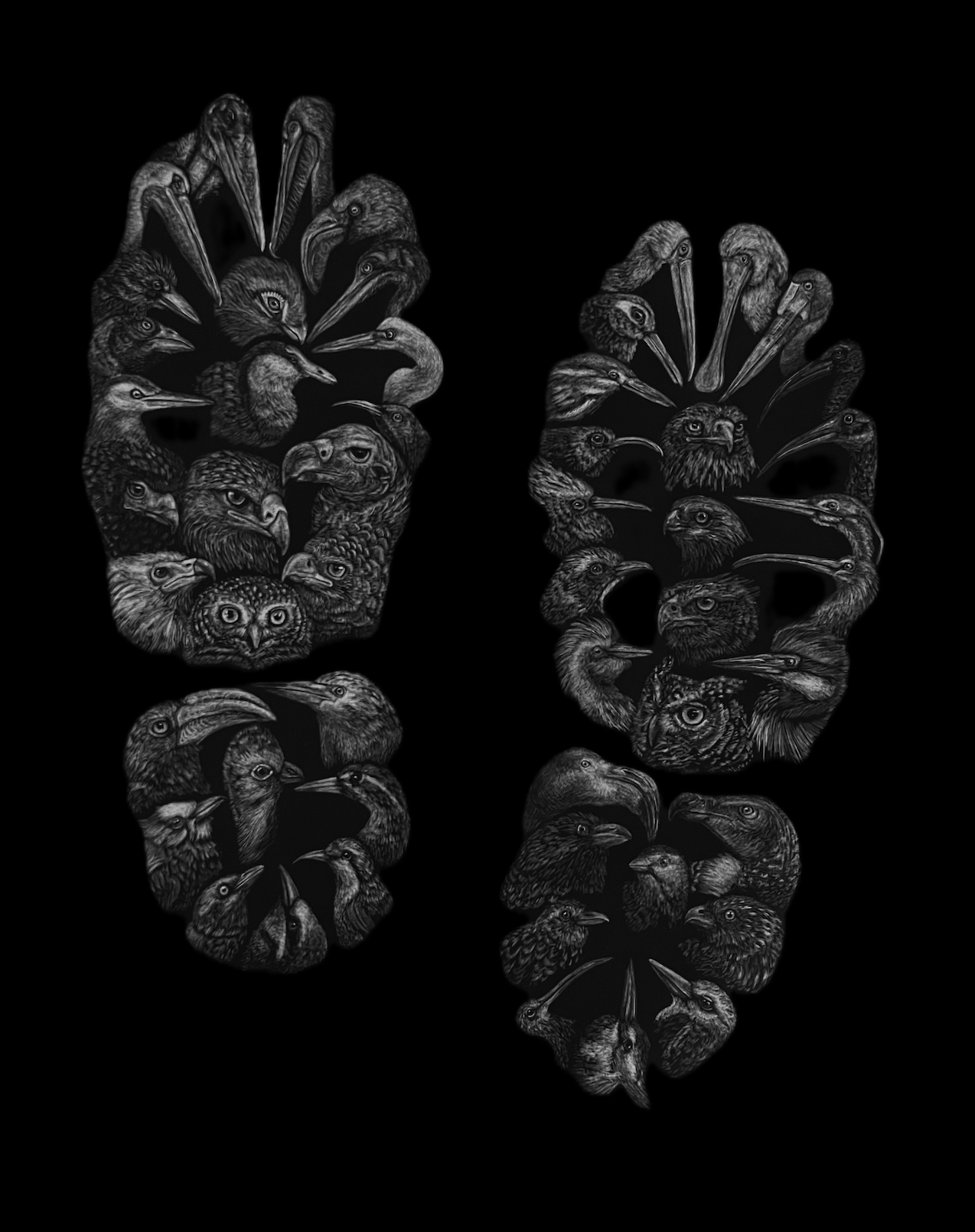
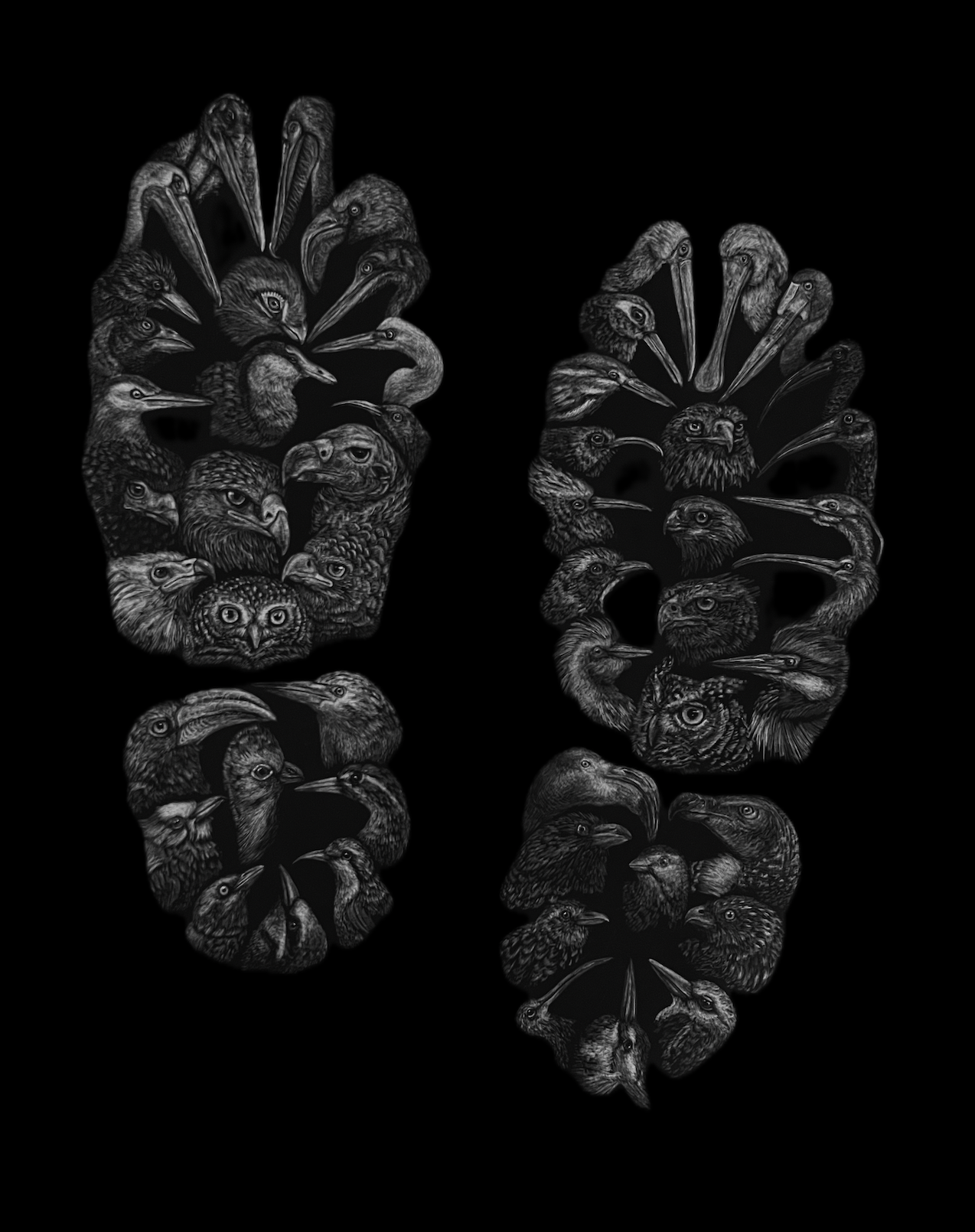
RANGER SERIES: GROUND MEETS SKY
18 x 24 inches
Ranger Series: Ground Meets Sky maps 53 bird species found on the Greater Ukuwela Nature Reserve inspired by the outline of a Jim Green AR8 ranger boot footprint - a piece of footwear synonymous with the daily commitment and hard work of conservation fieldwork, worn by the rangers of Wild Tomorrow. Each bird is rendered within the contours of the sole, its ridges and treads replaced by beak and plumage.
Birds are among the most mobile creatures on Earth, unbound by fence lines, roaming the skies. Yet their presence, their return to a place, depends entirely on what happens at ground level - especially in areas at risk of habitat loss – and is sustained by the persistent work of these very rangers wearing those boots.
In this piece, 53 species are made visible by what lies beneath. So too is the work of conservation - present not at the surface, but in what endures.
The ranger’s footprint is fleeting, but the impact of those who made it is not.
-
![]()
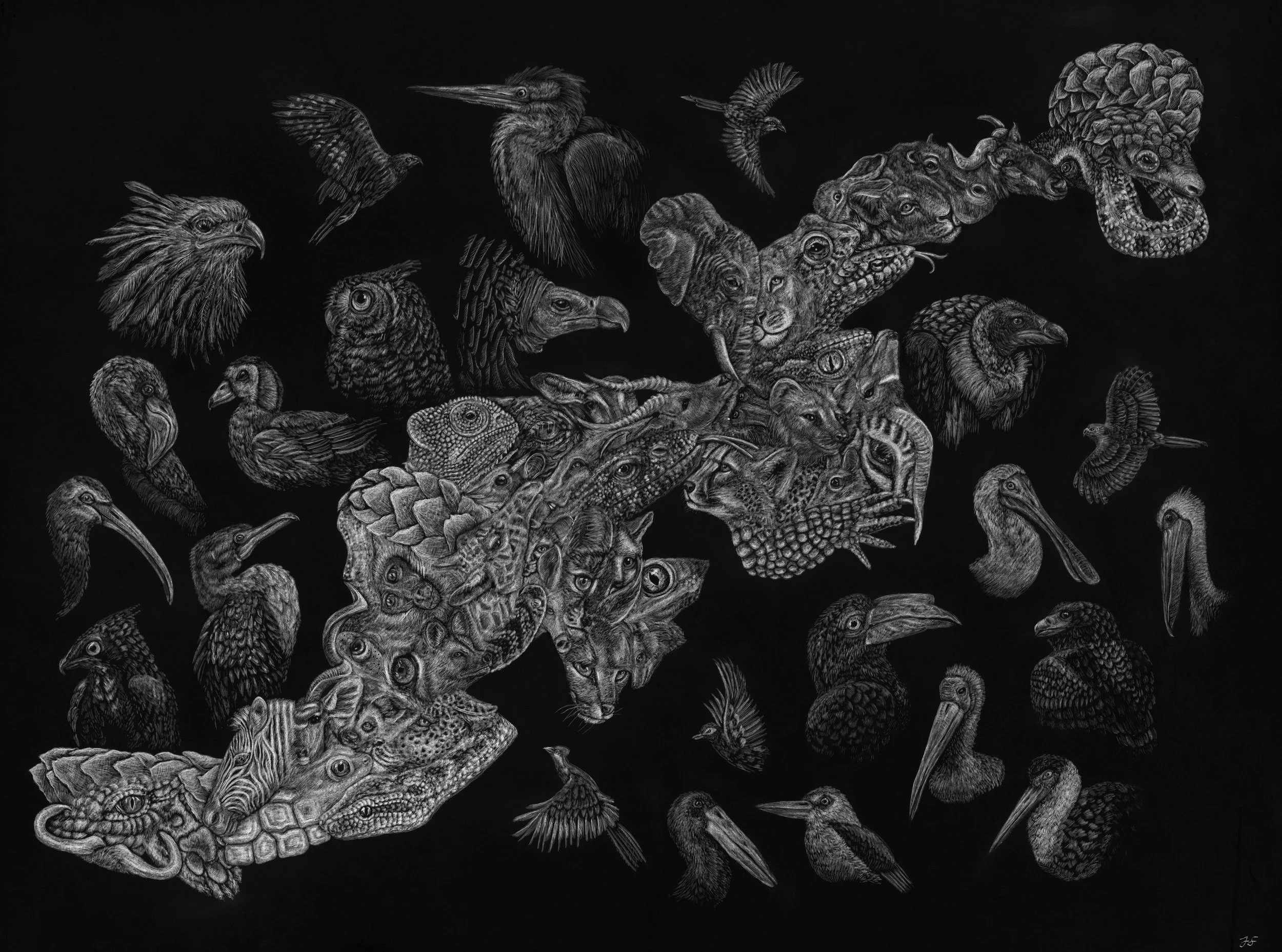
WILD CONNECTION
24 x 18 inches
Wild Connection depicts the Greater Ukuwela Nature Reserve, formed by the very animals that depend on it. The deconstructed elements merge into one another to trace an interconnected path of movement and survival. Through deconstructivism and deconstructionism, the piece reveals the inherent imperfection and interdependence of nature - a reminder that the natural world is shaped by the tension between chaos and cohesion.
Birds hover around the corridor - their distance from one another reflecting a scattered freedom, untethered yet still bound to the land below and the sky above. This contrast between land and sky reflects the delicate balance between separation and unity. This ecological corridor embodies both subject and symbol: a bridge between fragmented habitats where life that was once interrupted now begins to move as one again.
At its core, Wild Connection honors rewilding and the impact Wild Tomorrow has had on the land, not only as ecological restoration, but as a commitment to renewal, resilience, and reconnection.
These accomplishments depend as much on people as on wildlife. Please join me in honoring the rangers and local communities whose care sustains these vital links, allowing ecosystems to breathe, evolve, and thrive once more.
Restoring wild connections for a wild tomorrow.
-
![]()
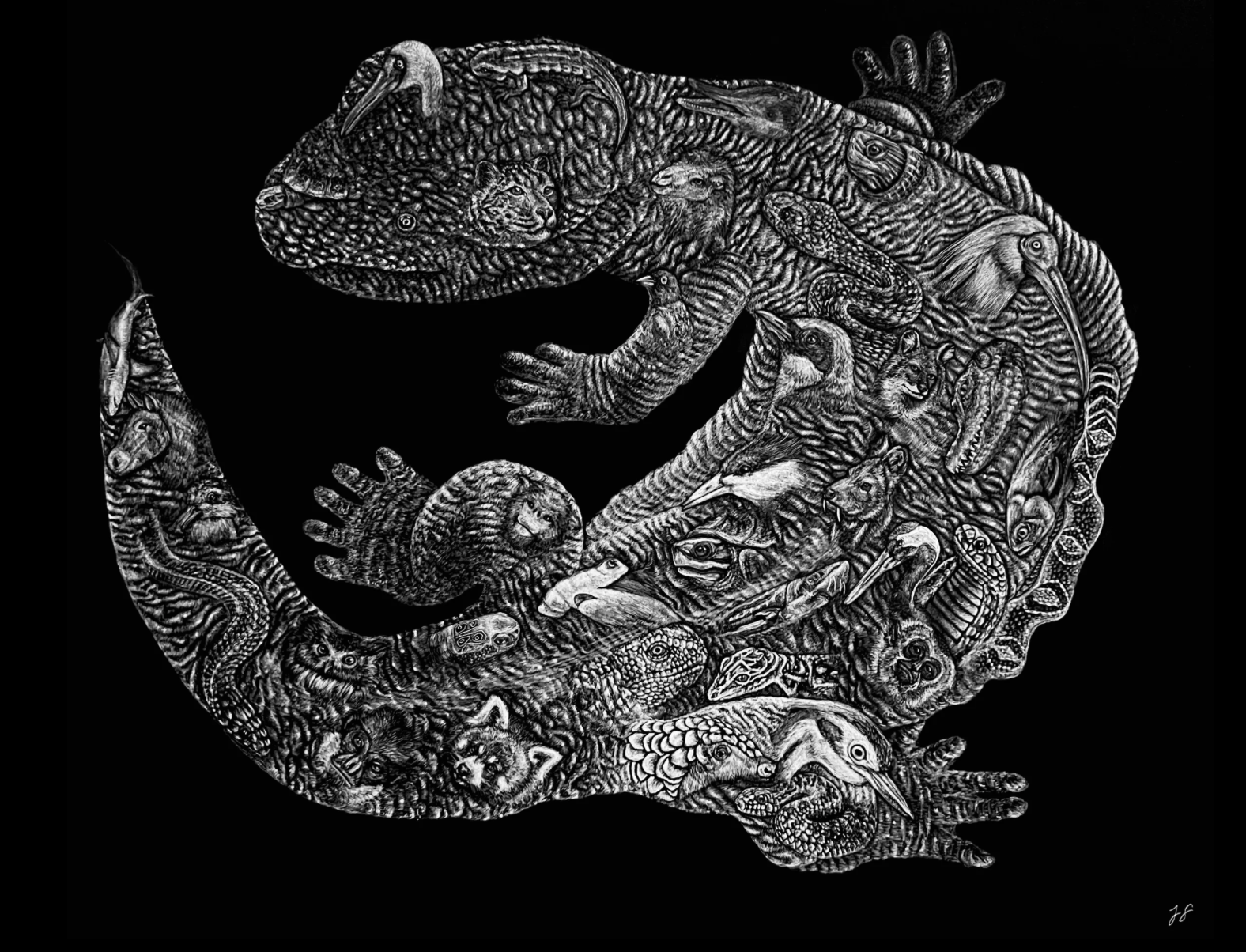
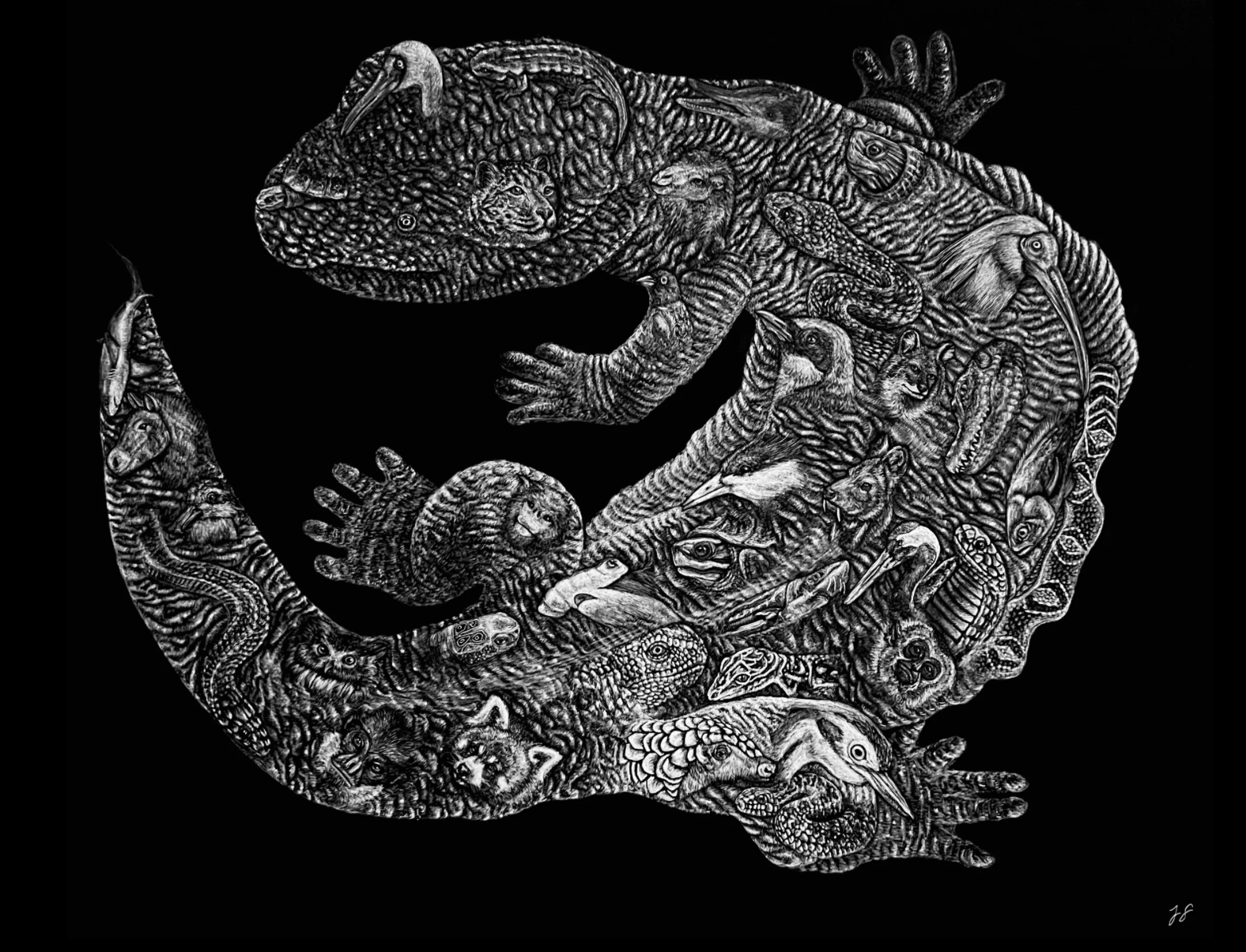
GIANT LOSS
24 X 18 inches
China is one of the world's 17 megadiverse countries, home to 15% of all vertebrate species and 12% of plant species, despite covering just 6% of the Earth's land area. However, this extraordinary biodiversity is under threat, with 22% of its vertebrate species and over 10% of all species in the country at risk due to habitat loss, pollution, overexploitation, and climate change.
My new art piece, Giant Loss, brings attention to this urgent issue by featuring a Chinese Giant Salamander with 37 endangered species native to China intricately blended into its body, symbolizing the interconnectedness and fragile balance of all species.
All the species featured in the artwork are listed on the ZSL EDGE of Existence species list.
More information on China and biodiversity:
https://carbon-pulse.com/341170/
https://www.sciencedirect.com/science/article/abs/pii/S0301479721015115
-
![]()
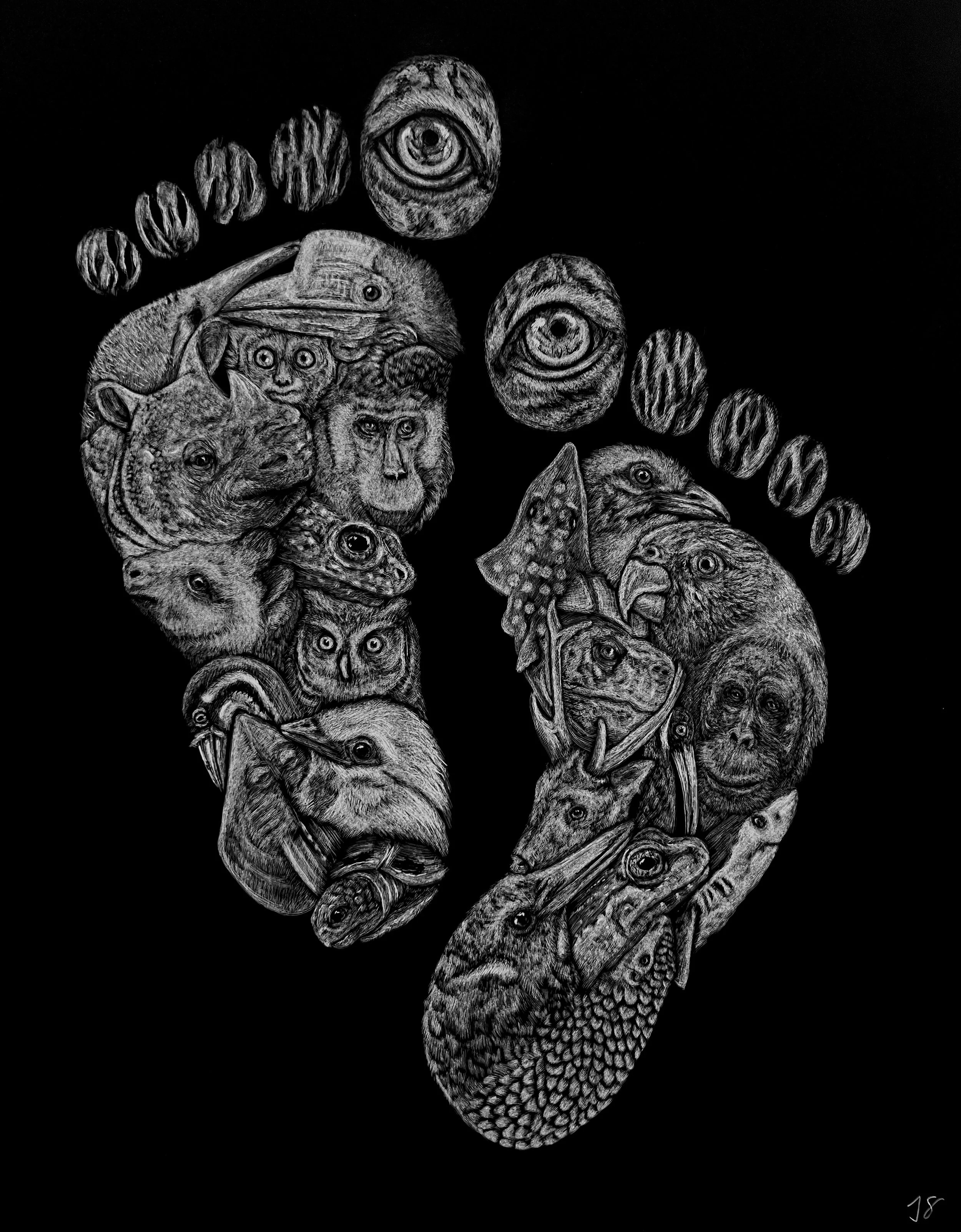
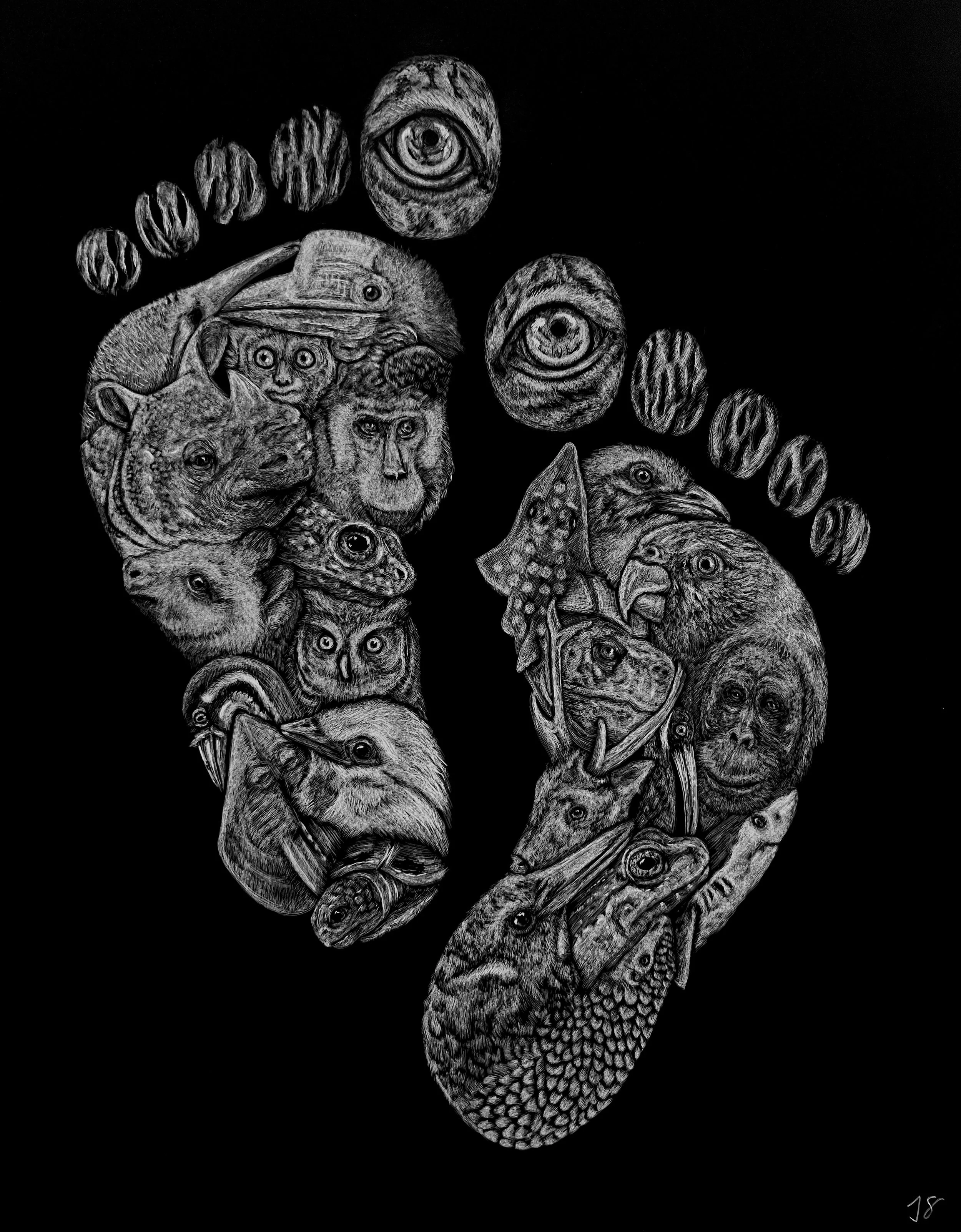
FRAGILE FOOTPRINT
11 X 14 inches
Our environmental footprint, marked by excessive habitat destruction and resource consumption, has strained the planet's natural systems and has led to the loss of numerous species. Our actions have disrupted ecological balance, resulting in a dramatic decline in biodiversity and the health of ecosystems.
This piece includes 24 critically endangered (IUCN) species endemic to Indonesia and are on the Zoological Society of London's (ZSL) EDGE list. Using a scientific framework to identify the world’s most Evolutionarily Distinct and Globally Endangered (EDGE) species, the ZSL EDGE of Existence program highlights and protects some of the most unique, extraordinary, and overlooked species on the planet. By focusing conservation efforts on these species, we can help preserve the ecological integrity of our planet.
-
![]()
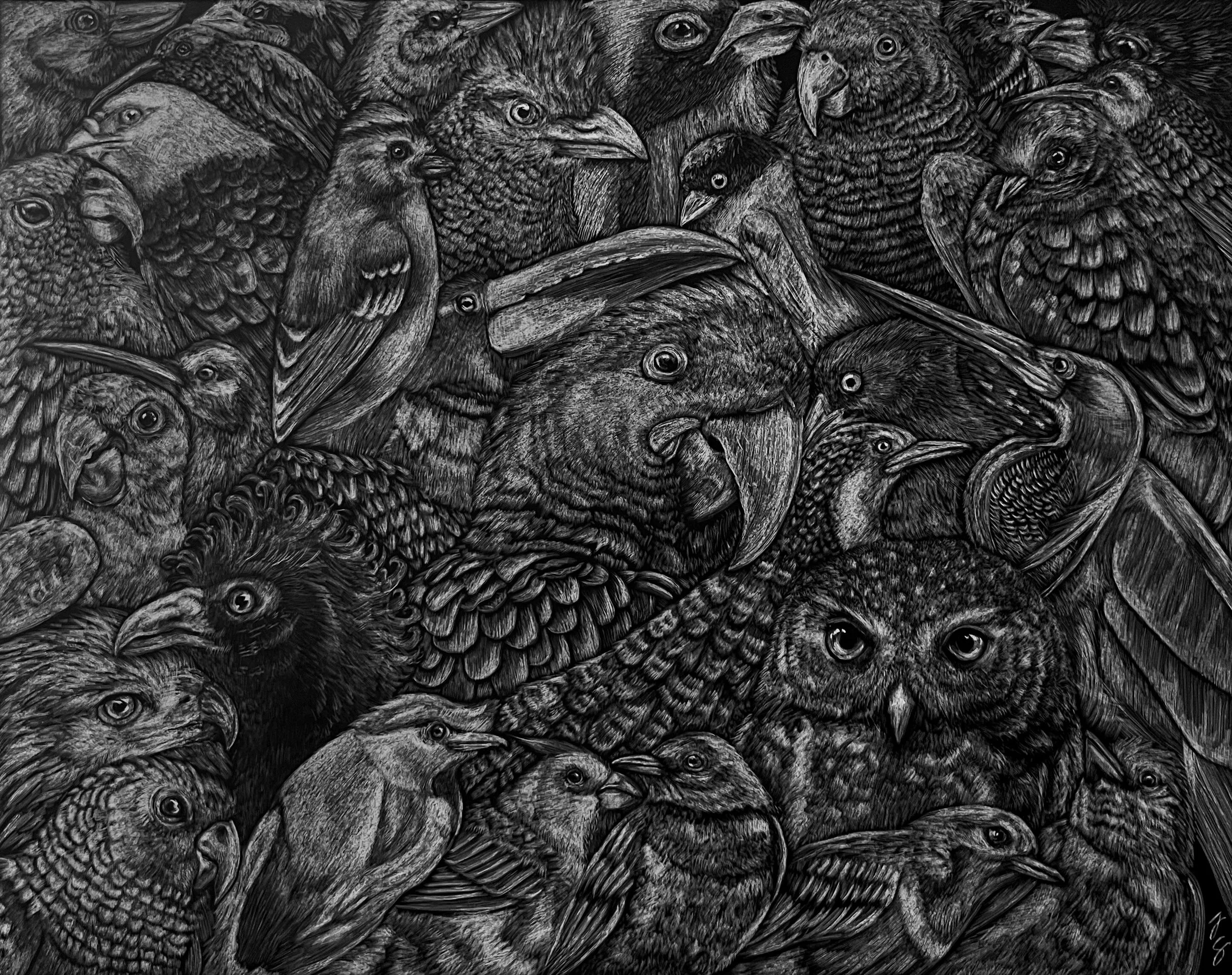
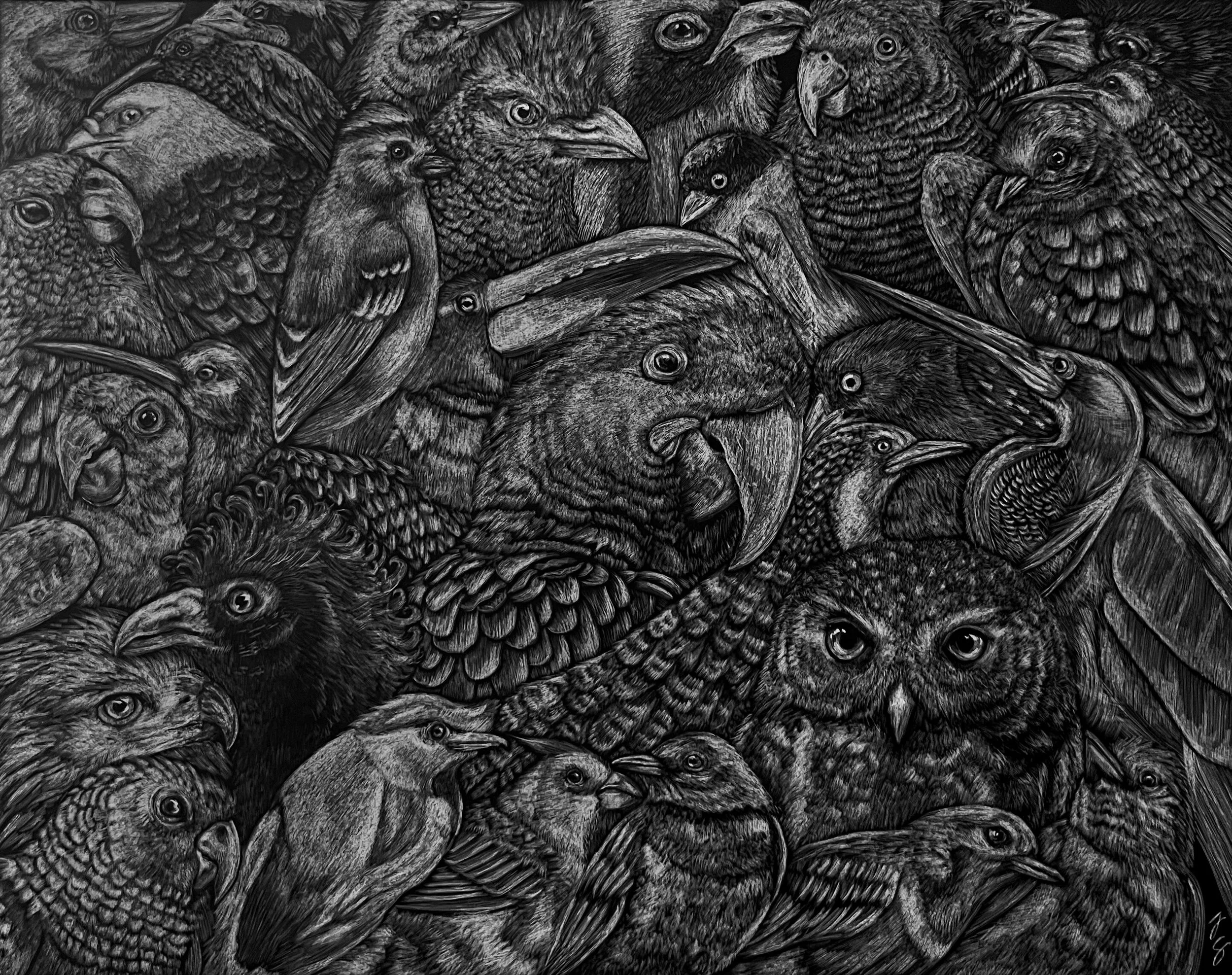
FEATHERED FUSION
This piece features 31 endangered bird species exclusive to Brazil and its neighboring regions, all of which are part of the Zoological Society of London's (ZSL) EDGE of Existence program.
-
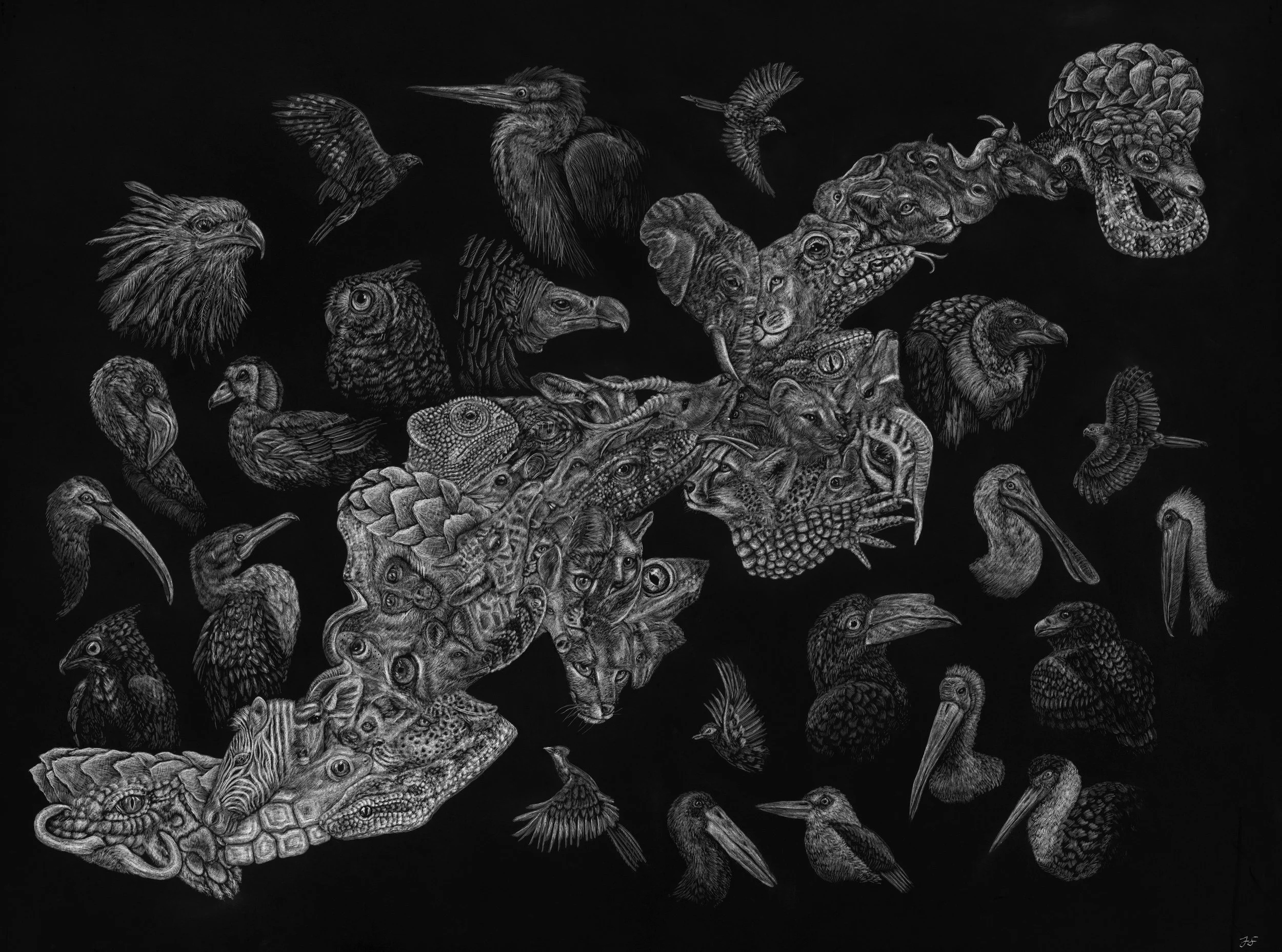
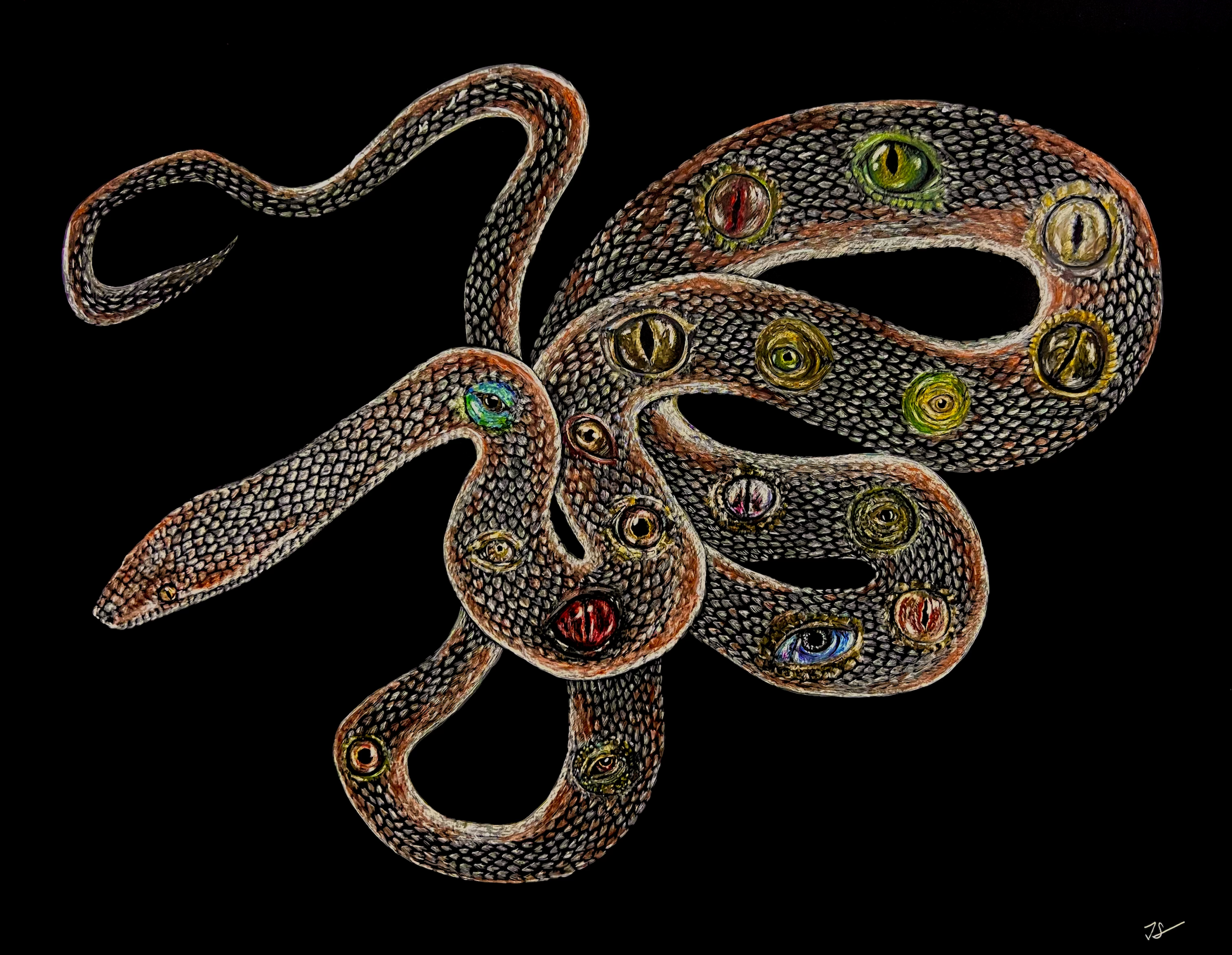
![]()
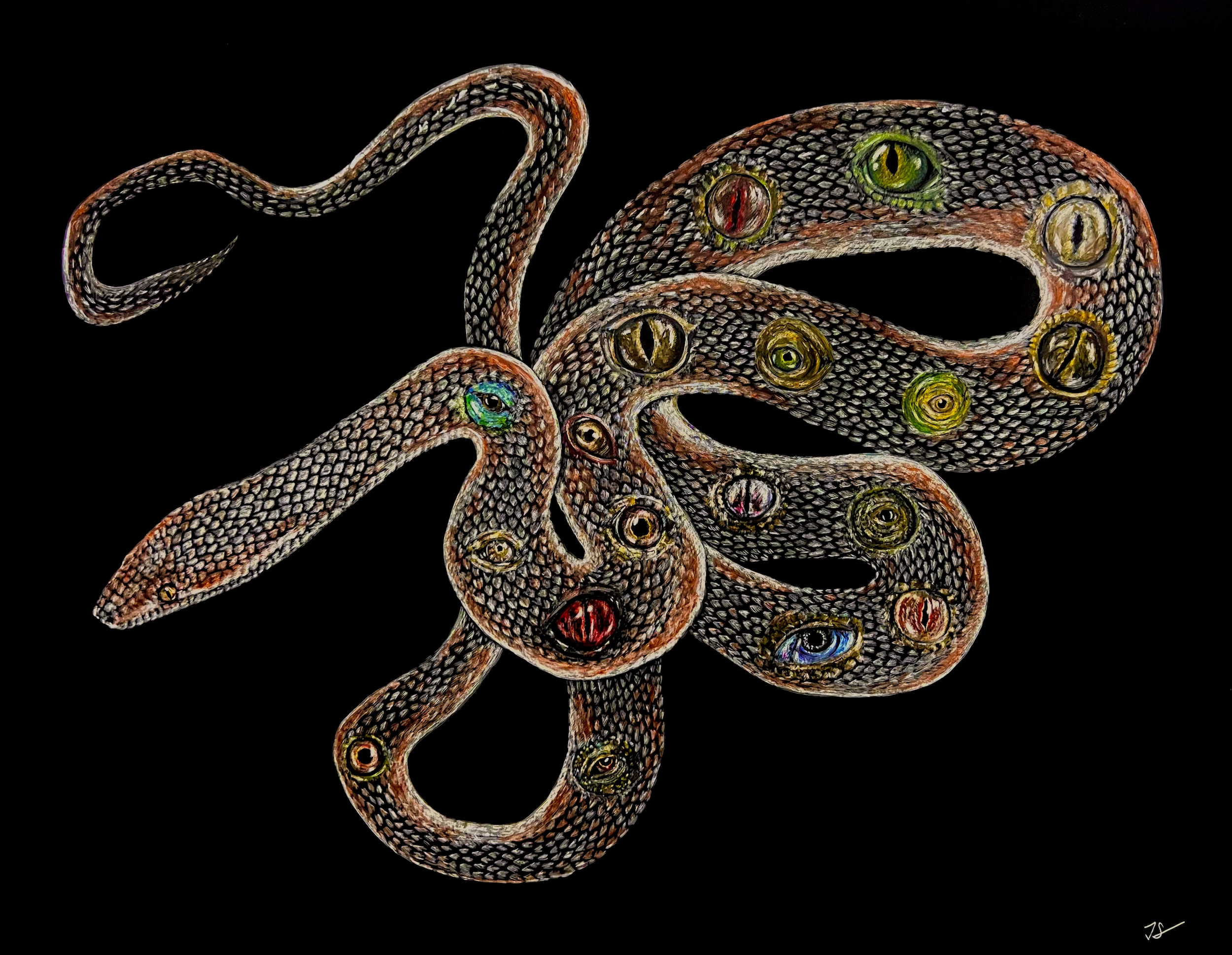
At Last Glance: Distinct and Dwindling
Dimensions: 14 x 18in
This piece incorporates reptile species (19) from the EDGE of Existence Reptile List, representing some of the most evolutionarily distinct yet critically endangered species on the planet. Most of the species featured in this piece have fewer than a handful of individuals left, with some being virtually extinct or last seen decades ago.
-
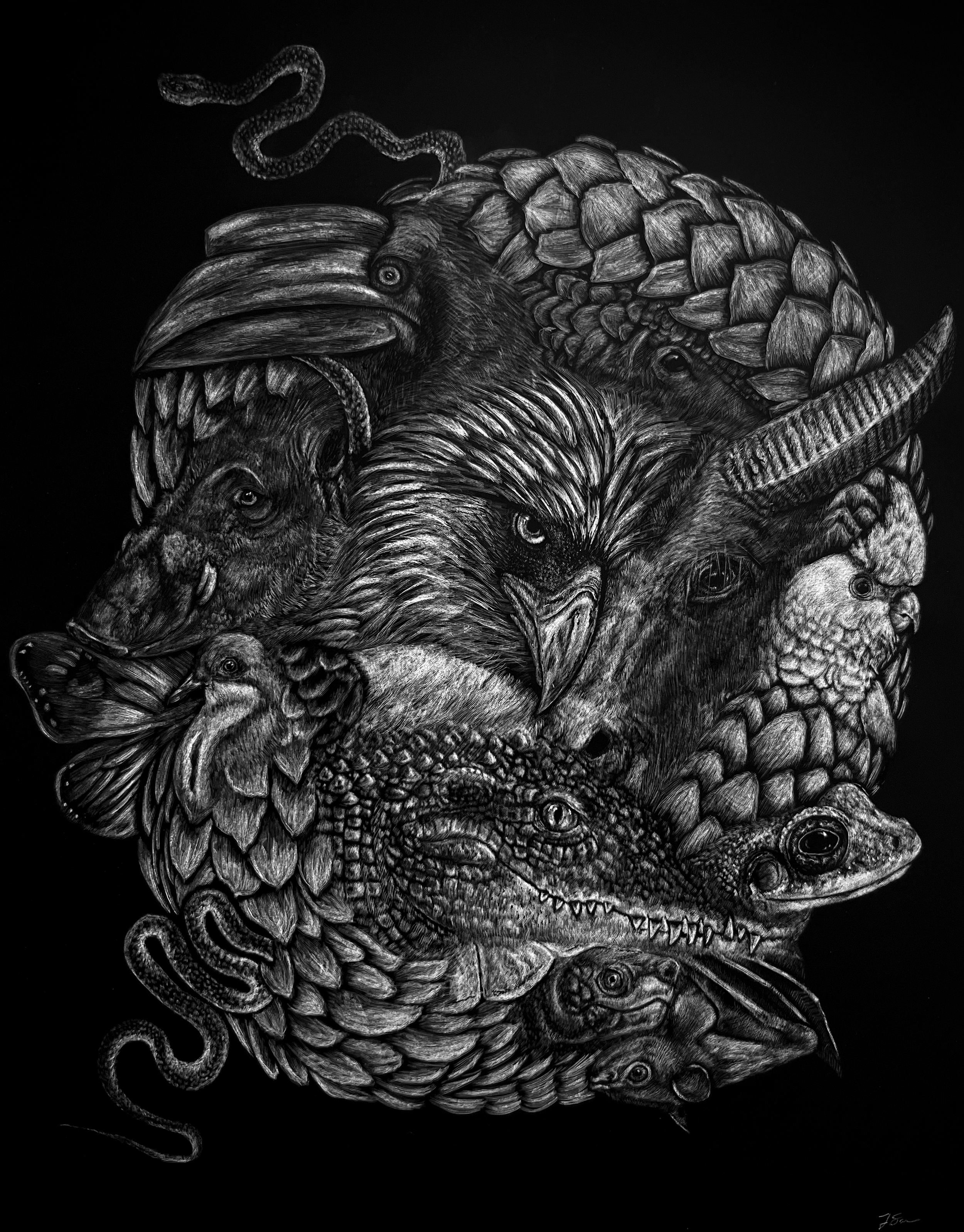
![]()
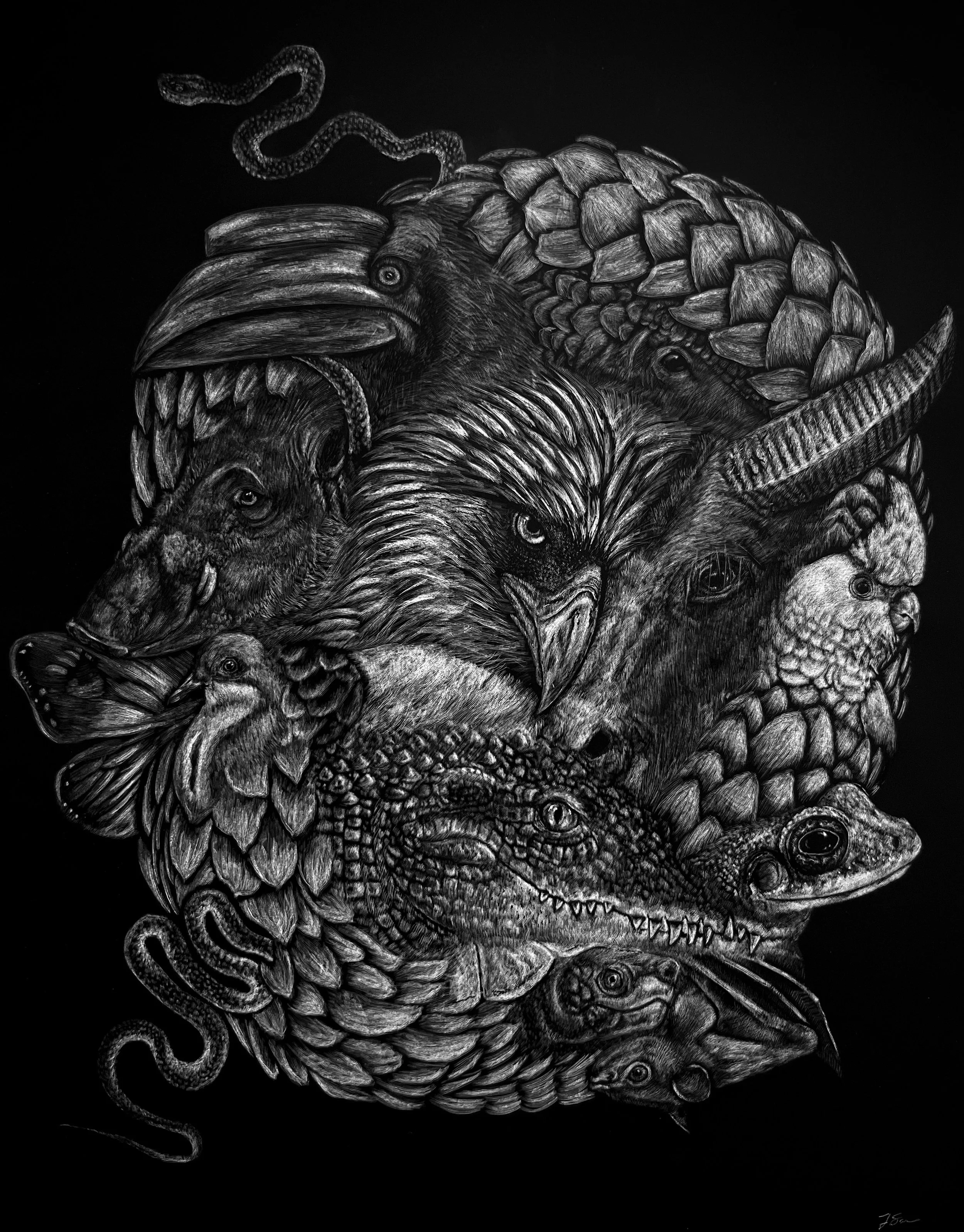
Circle of Survival - Kalikasan Kapwa
Dimensions: 11 x 14 inches
These animals are all native to the various islands of the Philippines, with some inhabiting multiple islands and others restricted to a single locale. Representing diverse branches of the animal kingdom, this artwork aims to illustrate the remarkable diversity and interconnectedness of these species.
The "Circle of Survival", depicted by the Palawan Pangolin in its protective position, symbolizes the cyclical nature of our interconnectedness with all life. It serves as a reminder that our actions profoundly affect the existence of others, and this relationship forms an unending cycle of cause and effect.
"Kalikasan" in Tagalog represents the natural world and the environment, while "Kapwa" underscores our interconnectedness with fellow human beings. This artwork signifies the deep bond between humanity and nature, highlighting that our actions have consequences not only for our own existence but for all the species that share our planet. It's a call to recognize and cherish this interconnected web of life and to strive for harmonious coexistence.Endemic Animals of the Philippines included (CR IUCN): Philippine Eagle, Philippine Crocodile, Tamaraw, Palawan Forest Turtle, Red-Vented Cockatoo, Visayan Warty Pig, Negros Bleeding-Heart, Palawan Pangolin, Sulu Hornbill, Philippine Naked Backed Fruit Bat, Ross’ Wolf Snake, Gigantes Limestone Frog, Parantica Davidi
-
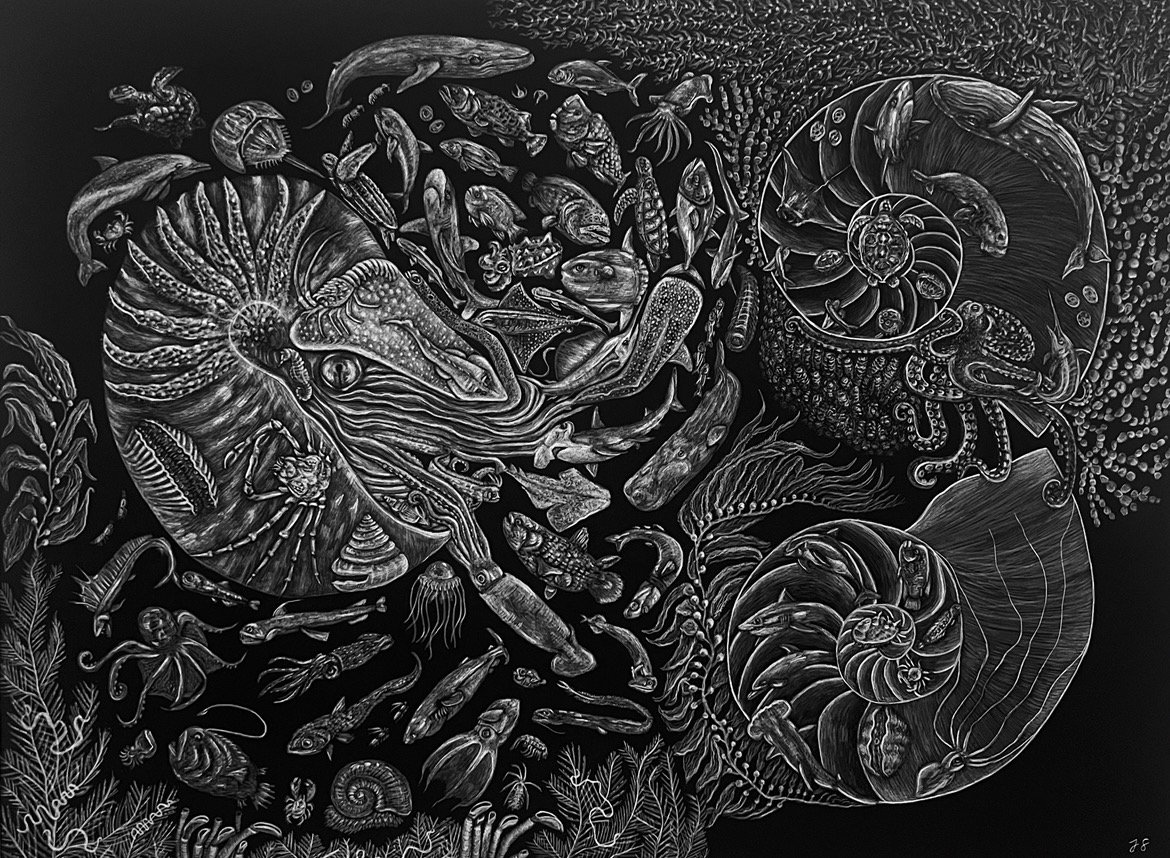
![]()
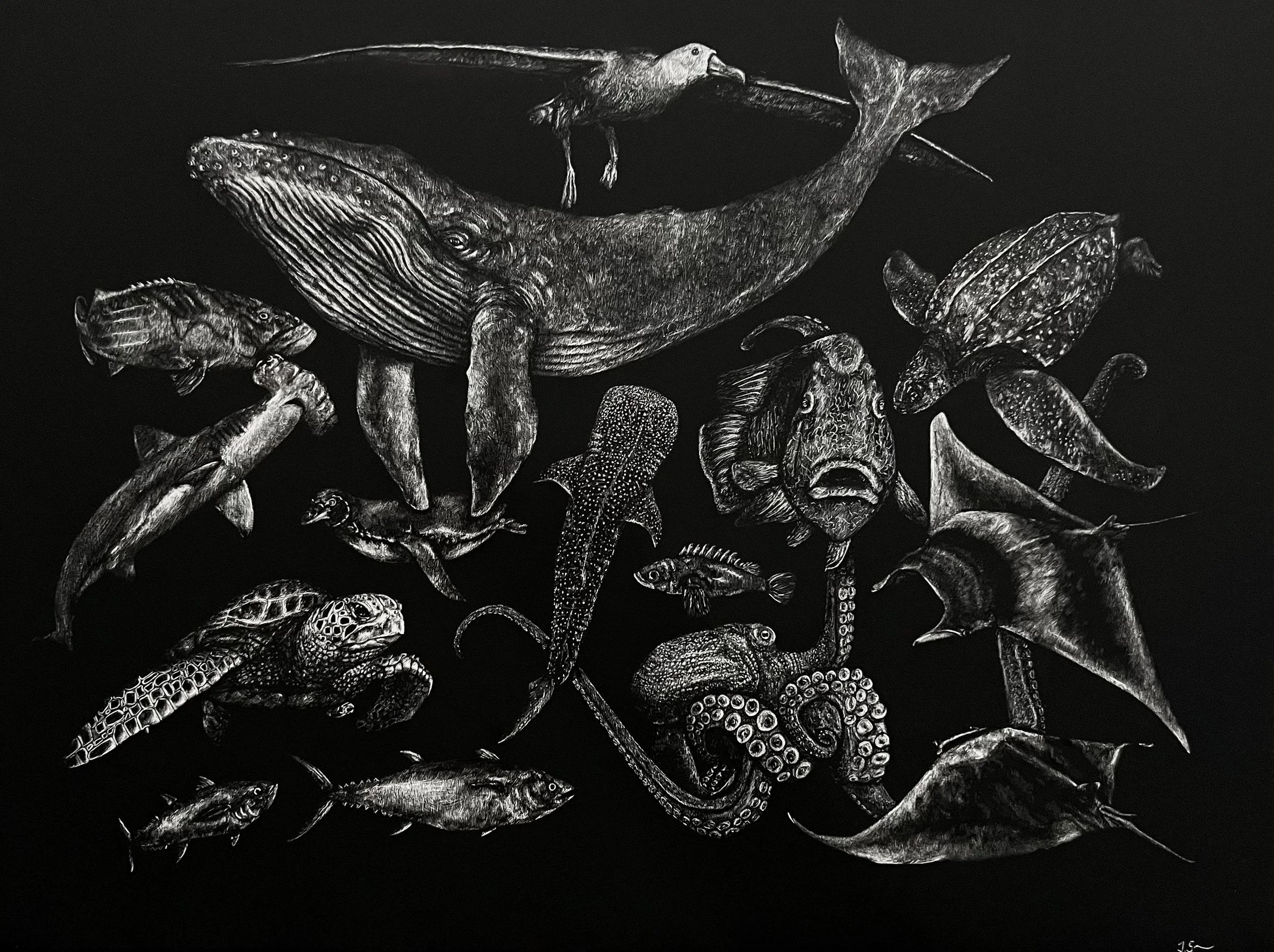
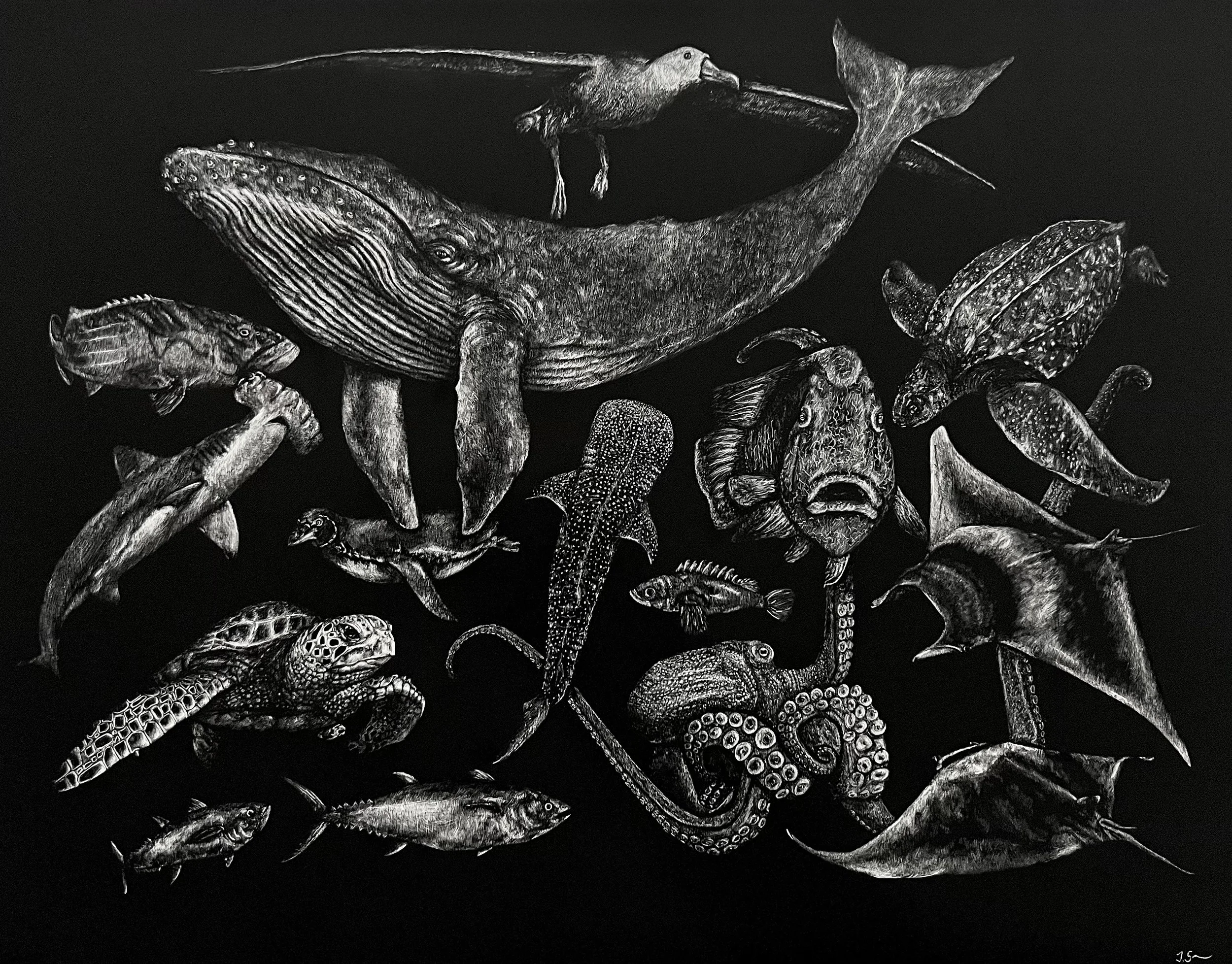
Ripple of Extinction
Dimensions 18 x 24 inches
Halt overfishing, bycatch, habitat loss, pollution, and climate woes.
Waved Albatross (CR), Blue Whale (EN), Goliath Grouper (CR), Scalloped Hammerhead (CR), Galapagos Penguin (EN), Hawksbill Sea Turtle (CR), Bluefin Tuna (EN/VU), Whale Shark (EN), Acadian Redfish (EN), Humphead Wrasse (EN), Leatherback Sea Turtle (VU), Giant Oceanic Manta Ray (EN), Giant Pacific Octopus (LC)
-
![]()
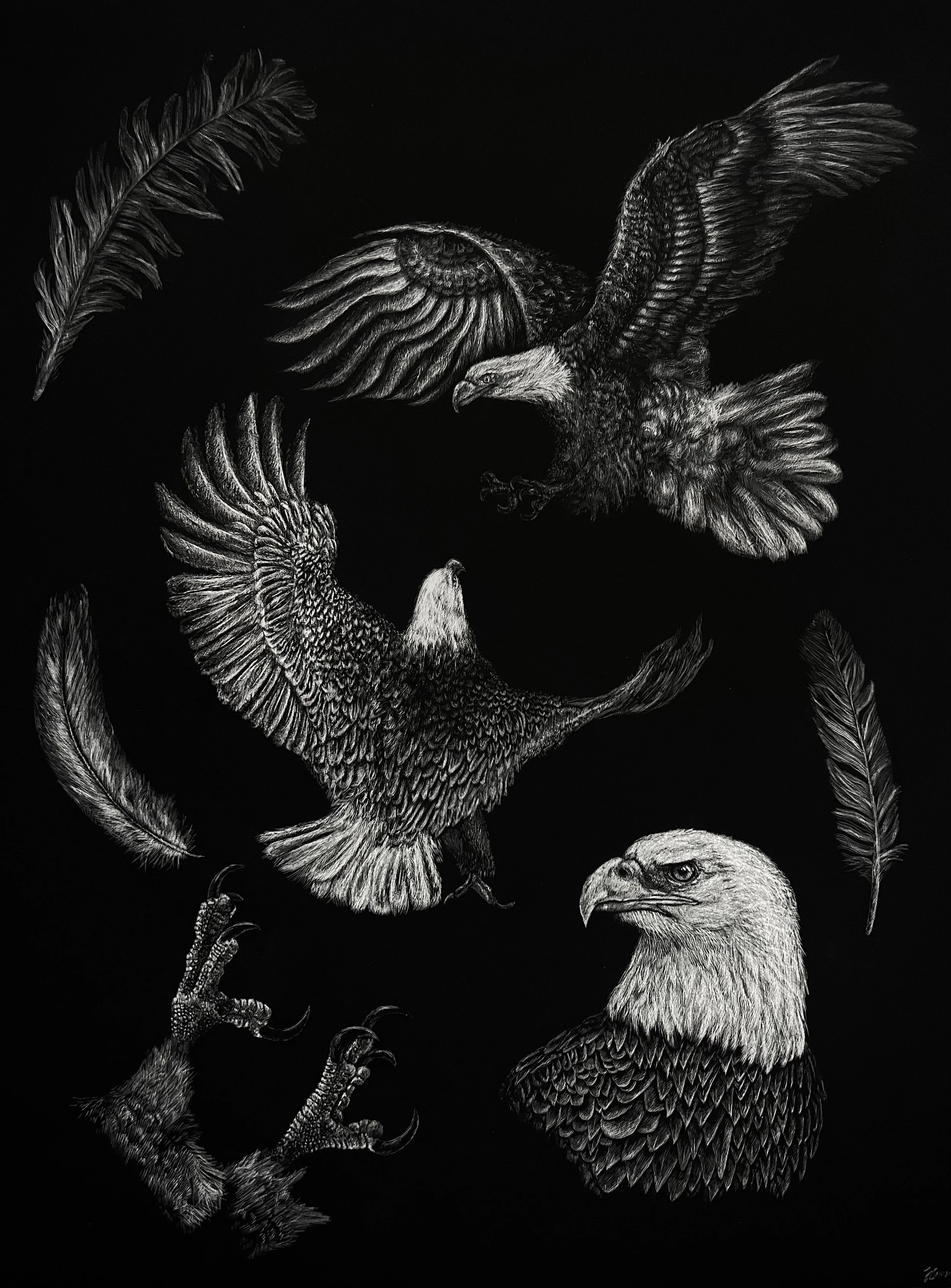
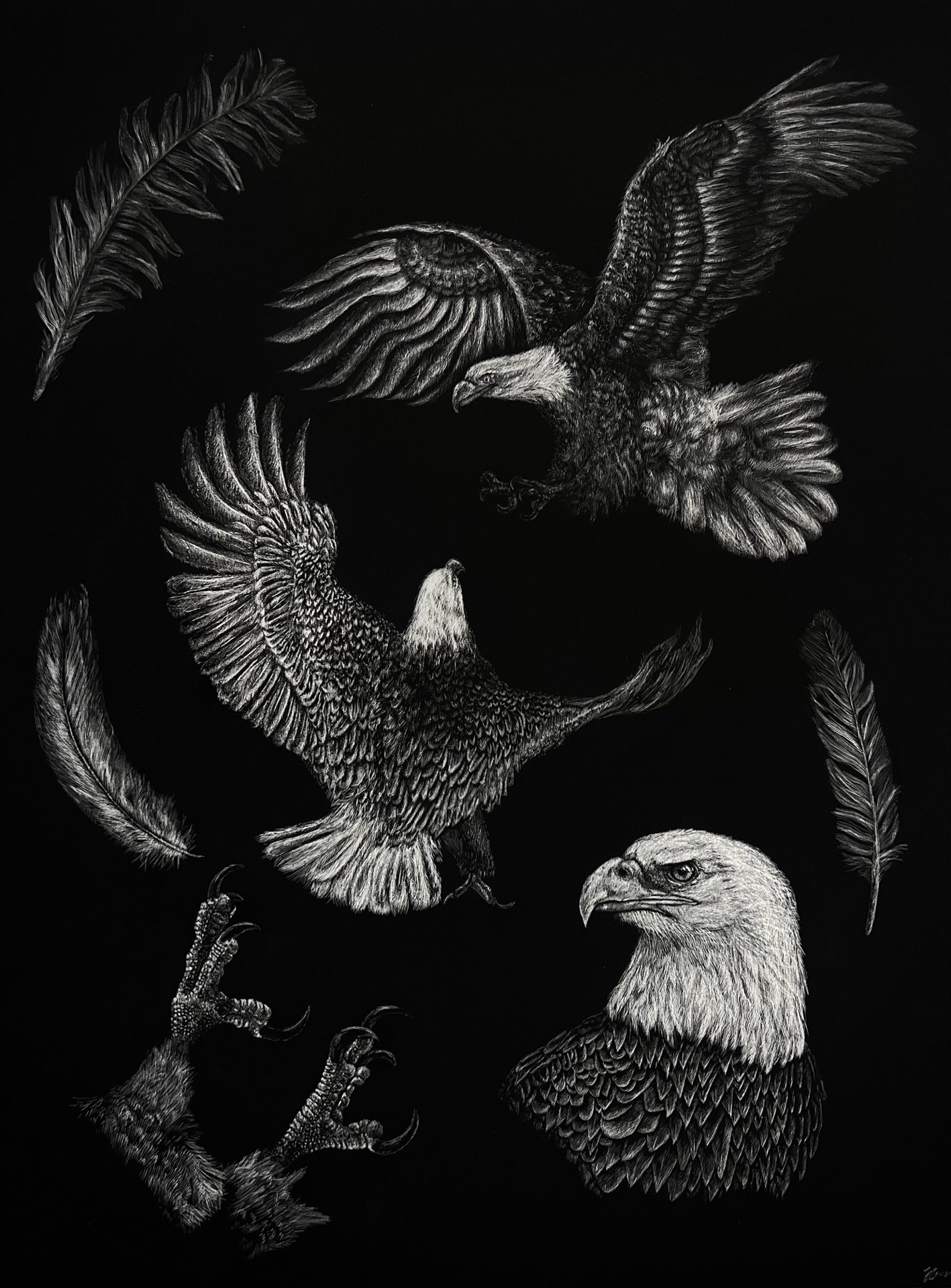
Rebirth of Detail: Honoring the Bald Eagle’s Recovery
Dimensions: 16 x 20in
Once on the brink of extinction in the continental United States, the Bald Eagle has become one of the most celebrated examples of wildlife recovery. Decimated by habitat loss, persecution, and the effects of DDT, its resurgence stands as a testament to the power of conservation, environmental policy, and public stewardship.
Rendered in scratchboard, Rebirth of Detail pays tribute to this remarkable journey. Through intricate detail and contrast, the piece reflects both the resilience of the species and the collective efforts that helped restore it to North America's skies. The Bald Eagle's recovery serves as a reminder that when people choose to act, even species facing seemingly insurmountable challenges can be given a second chance.
-
![]()
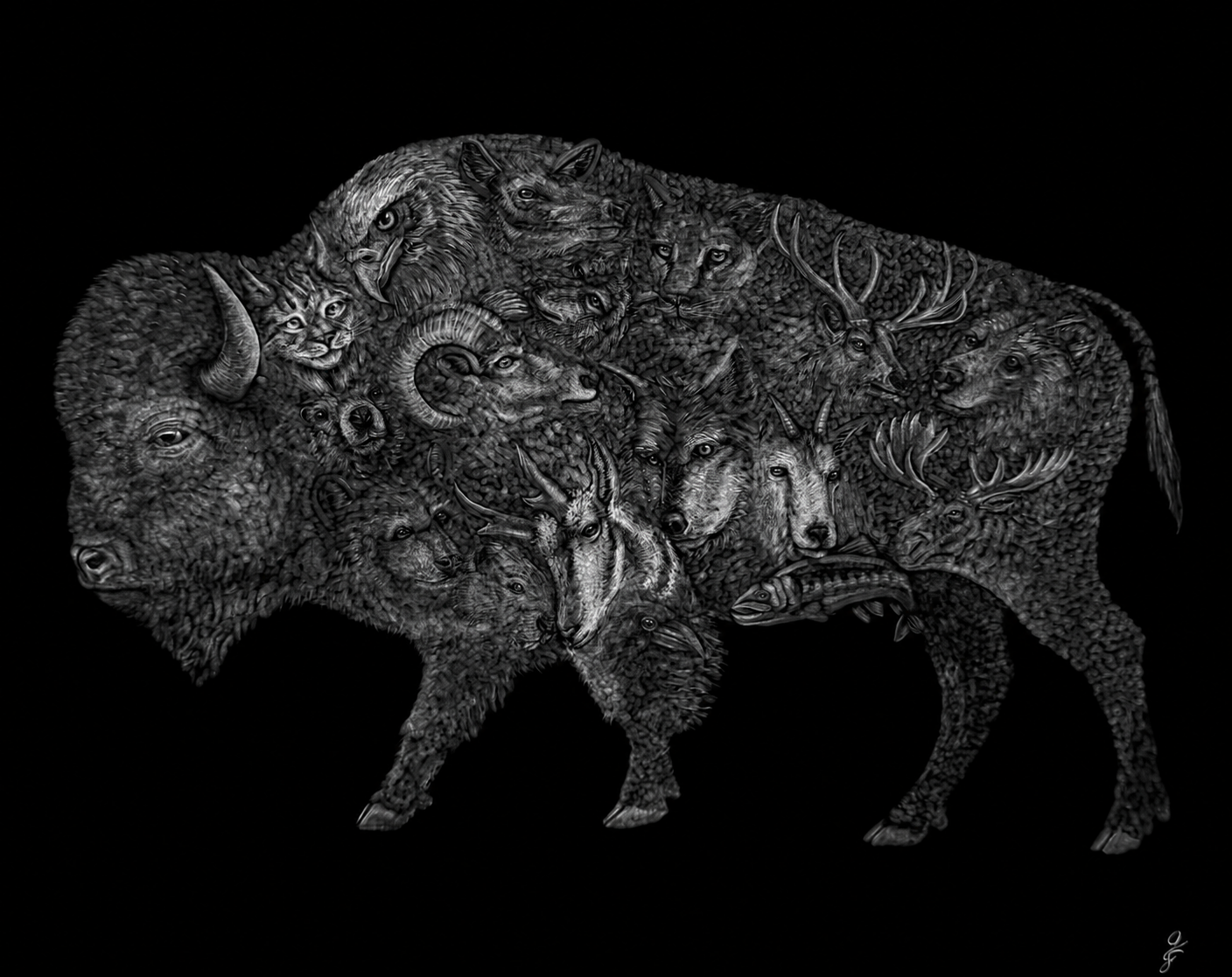
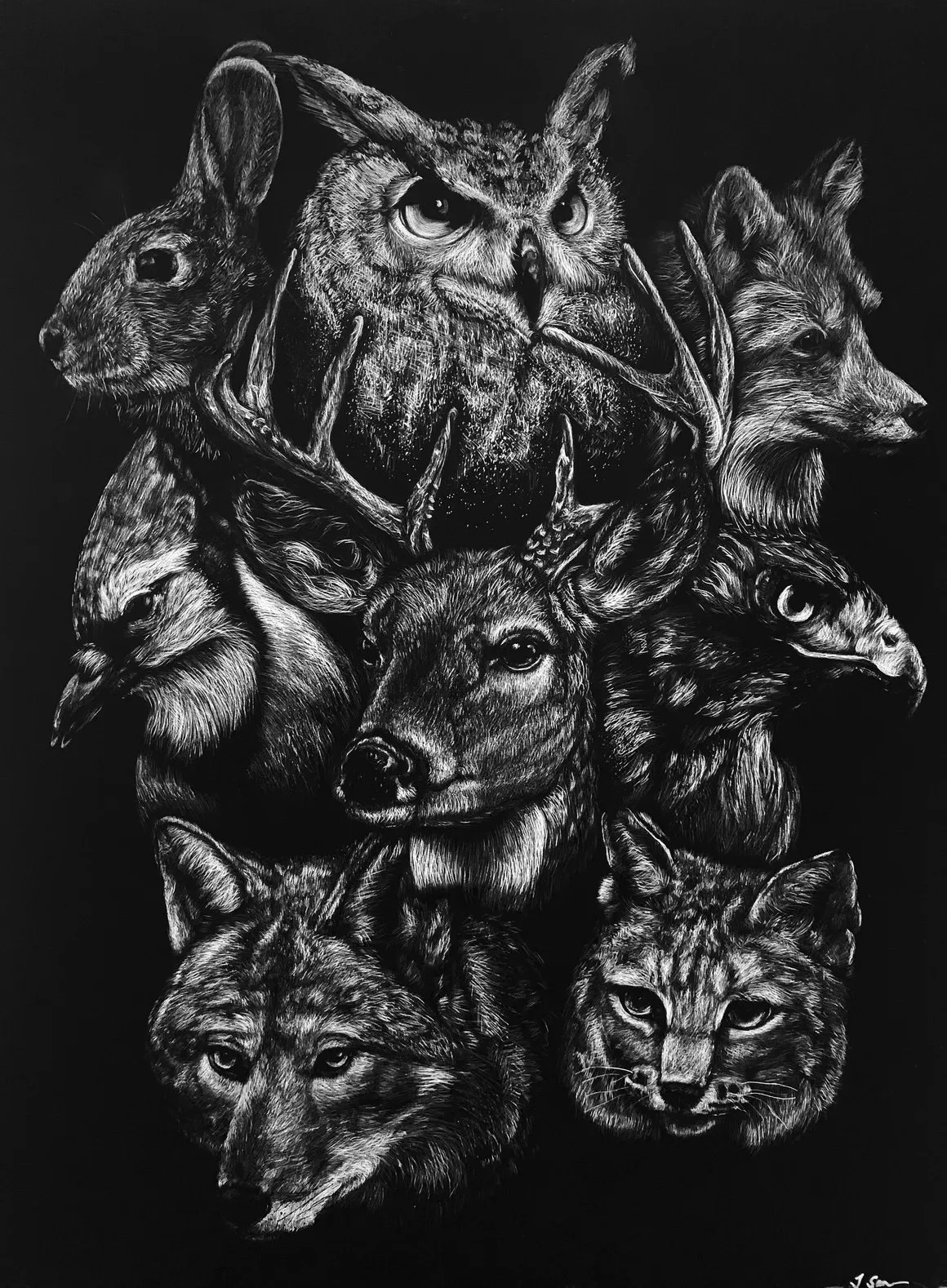
ONE WILDERNESS
12 × 18 inches
Personal account from the artist:
Few places have made me feel as connected to my surroundings as Yellowstone. Its vast landscapes and flourishing wildlife embody what I believe observing animals should be: seeing them living freely, on their own terms, in the habitats that have sustained them for generations.
There is something about the American West - the wildness of it - that has always tugged at my heartstrings. Yet that beauty exists alongside an ongoing and complicated struggle to protect these lands and its wildlife. Watching the political and legal battles on filling wetlands, or delisting protected species, unfold from afar can leave me feeling helpless. If you have ever felt that same mixture of wonder, concern, and helplessness, you are not alone.
This piece grew partly out of those feelings, but also out of experimentation. It is one of the first works I have created without an intended recipient or destination and instead challenged myself to work quickly. The result was probably my fastest completed piece yet.
In a way, that spontaneity feels fitting for the subject. Yellowstone reminds me that there are still places where animals can simply exist as animals - moving across immense stretches, undistributed, that belong to something much larger than ourselves. This piece is, in part, my small tribute to that wildness and to the hope that we continue making room for it.
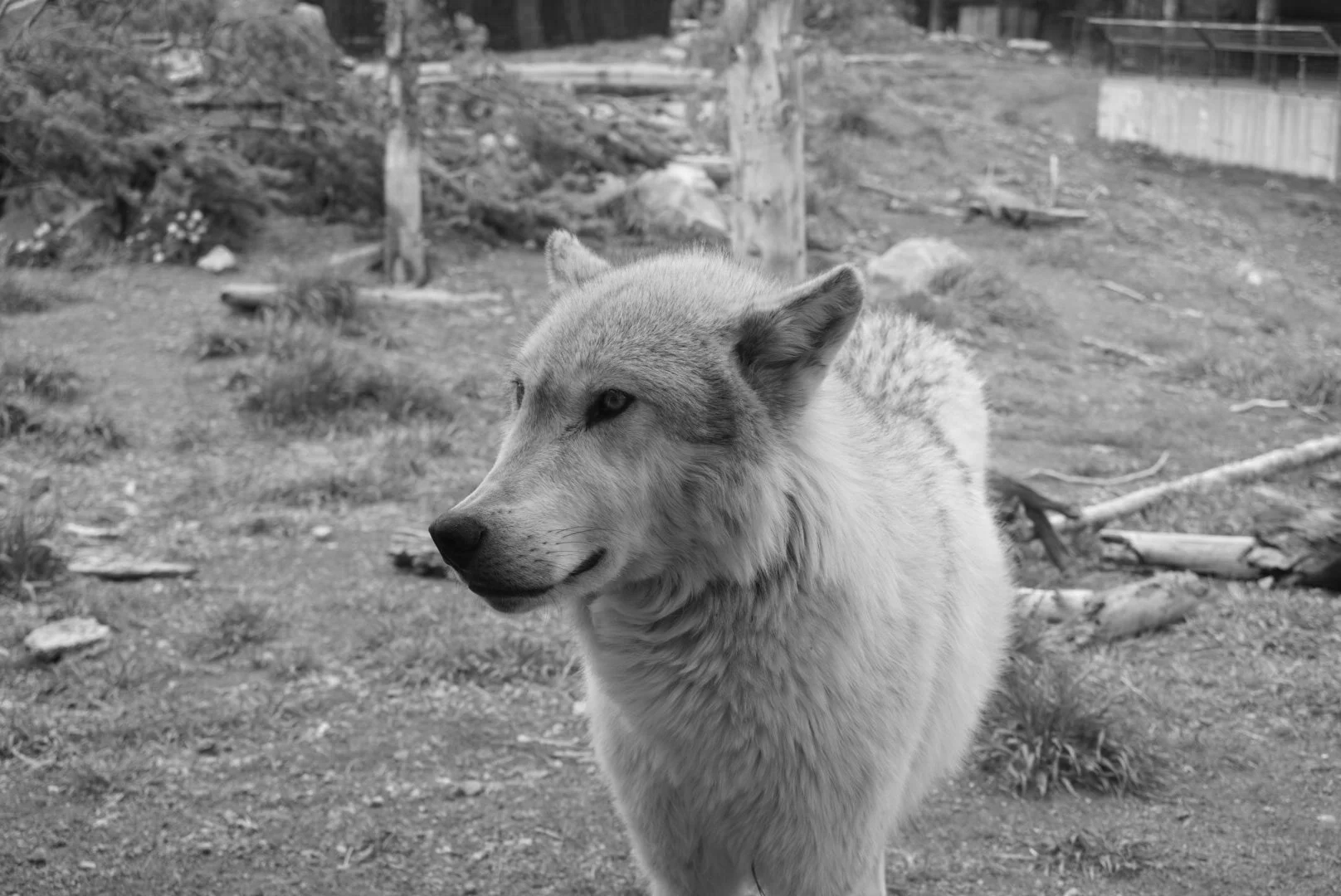
And, of course, I had to include Wolf 926F - the “Queen of the Wolves.” Reading her story, and learning of her unyielding resilience through everything she endured, has been nothing short of inspiring. To me, she embodies so much of what makes Yellowstone and its wildlife extraordinary: wildness, endurance, and the instinct to persevere.